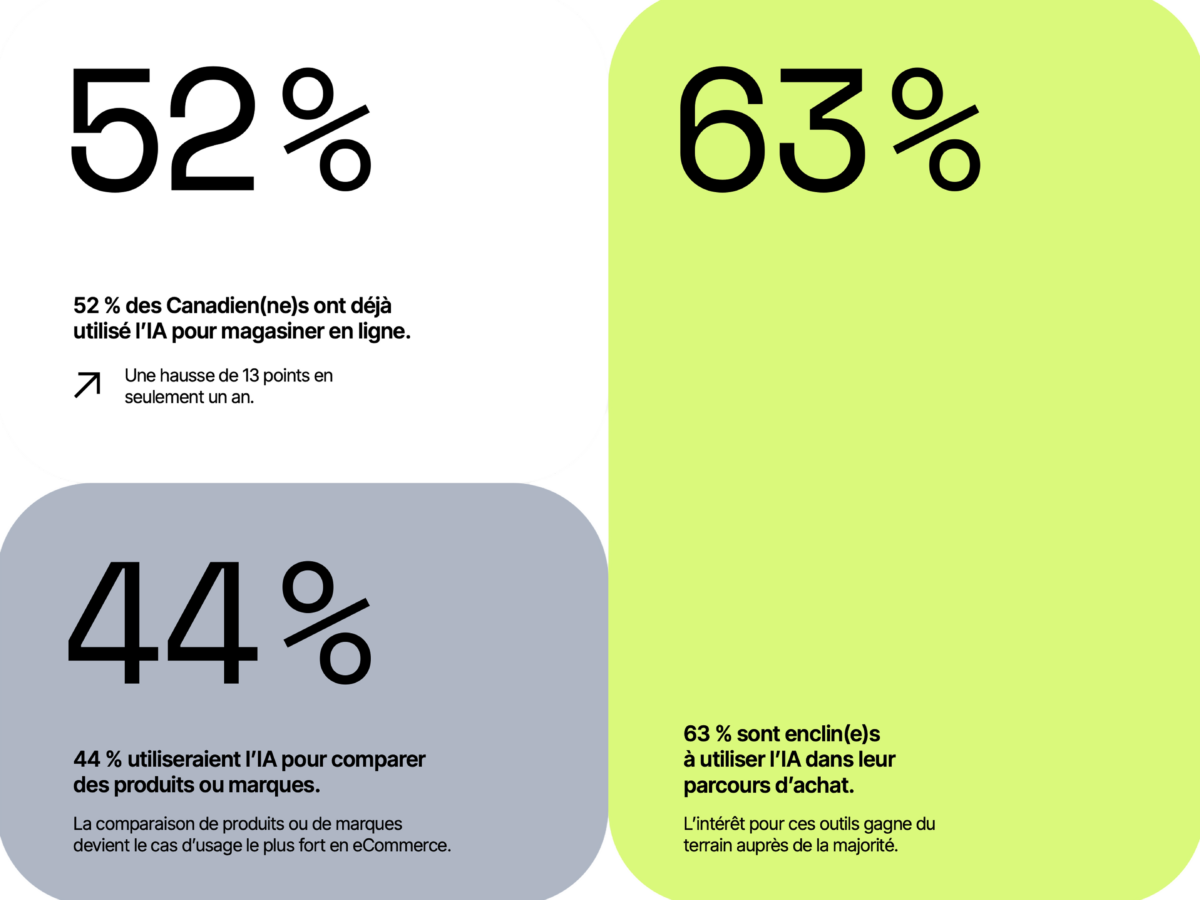
The growing adoption of AI does not mean that every retailer needs to quickly add an intelligent assistant to their website. A poorly targeted integration can even add complexity rather than simplify the customer experience.
Instead, the first step is to identify the moments in the customer journey where customers need the most support.
1. Prioritize complex decisions
Retailers should start with the categories where customers hesitate the most, compare options more extensively, or contact customer service more often before making a purchase.
A few useful questions to ask:
- Which products generate the most questions before purchase?
- Which categories have high return rates?
- Where do customers drop off in their journey?
- Which purchases require the most comparison or explanation?
- What information is often missing or difficult to understand?
These areas often represent the best starting points for testing AI use cases.
AI depends heavily on the quality of the data available. If product pages are incomplete, inconsistent, or poorly structured, AI tools will have more difficulty interpreting the product offering, recognizing products, and providing relevant recommendations.
Retailers should therefore review the quality of their product information: titles, descriptions, attributes, variants, compatibility, dimensions, availability, return policies, delivery times, and customer reviews. To make comparisons possible across different environments, it is also becoming essential to use universal identifiers such as SKUs, GTINs, UPCs, or EANs. These identifiers make it easier to reliably recognize a product, even when it is presented across multiple platforms, channels, or catalogues.
Beyond the content visible to customers, the technical structure of this information is becoming just as important. The use of semantic HTML, standardized attributes, and structured data—particularly JSON-LD based on Schema.org standards—helps search engines, AI assistants, and conversational agents understand products more accurately. It also makes product attributes more readable in the formats expected by new protocols related to agentic commerce, such as UCP and ACP.
Without this structure, AI tools may make assumptions, misinterpret certain information, or simply overlook a product. Good product data is therefore no longer just about improving the experience on a website. It is becoming essential for products to be understood, compared, and recommended in shopping journeys increasingly influenced by AI.
2. Improve the quality and structure of product information
AI depends heavily on the quality of the data available. If product pages are incomplete, inconsistent, or poorly structured, AI tools will have more difficulty interpreting the product offering, recognizing products, and providing relevant recommendations.
Retailers should therefore review the quality of their product information: titles, descriptions, attributes, variants, compatibility, dimensions, availability, return policies, delivery times, and customer reviews. To make comparisons possible across different environments, it is also becoming essential to use universal identifiers such as SKUs, GTINs, UPCs, or EANs. These identifiers make it easier to reliably recognize a product, even when it is presented across multiple platforms, channels, or catalogues.
Beyond the content visible to customers, the technical structure of this information is becoming just as important. The use of semantic HTML, standardized attributes, and structured data—particularly JSON-LD based on Schema.org standards—helps search engines, AI assistants, and conversational agents understand products more accurately. It also makes product attributes more readable in the formats expected by new protocols related to agentic commerce, such as UCP and ACP.
Without this structure, AI tools may make assumptions, misinterpret certain information, or simply overlook a product. Good product data is therefore no longer just about improving the experience on a website. It is becoming essential for products to be understood, compared, and recommended in shopping journeys increasingly influenced by AI.
3. Make comparisons more useful
Since comparison is the strongest use case, retailers should structure their content around the criteria that actually influence purchasing decisions.
A good comparison tool should not simply display products side by side. It should help customers understand what really differs from one option to another: performance, recommended use, compatibility, durability, maintenance, total cost, availability, warranty, or level of service.
To achieve this, information needs to be standardized and comparable from one product to another. For example, two products should not describe the same feature in three different ways. Attributes should be consistent, easy to understand, and presented in formats that are easy to interpret, both for customers and AI tools.
The goal is therefore not simply to provide more information, but to make that information clearer, more reliable, and easier to use. This structure allows customers, search engines, and AI agents to compare the right information at the right time and support more informed purchasing decisions.
4. Summarize customer reviews
Customer reviews have become an essential source of information, but they can be difficult to navigate when there is a large volume of them. AI can help summarize recurring themes such as quality, sizing, comfort, installation, durability, noise, performance, after-sales service, or value for money.
For retailers, this is an opportunity to help customers understand a product’s strengths and limitations more quickly. It can also strengthen trust, provided that summaries remain transparent, nuanced, and based on genuine customer reviews.
5. Keep a “human in the loop”
AI can simplify many steps in the customer journey, but it does not completely replace the role of customer service representatives or advisors.
For complex purchases, sensitive situations, or cases where trust is essential, human support remains important. Retailers should therefore design hybrid experiences: AI can answer simple questions quickly, narrow down options, or summarize information, while people can support customers through more complex decisions.